
“And so I ask myself: 'Where are your dreams?' And I shake my head and mutter: 'How the years go by!' And I ask myself again: 'What have you done with those years? Where have you buried your best moments? Have you really lived?" Fyodor Dostoyevsky, White Nights

terça-feira, 3 de novembro de 2015

The 16 Best Movies About Female Mental Illness

22 March 2015 Features, Film Lists by Torie Gehrig
female mental illness movies
Understanding the mind has never been easy. When an ailment is not psychically tangible, it is easy to dismiss. This is especially true when you try to understand the minds of a population of individuals, who, until the last 100 years or so, were supposed to be seen rather than heard.
Ever since the genesis of its practice, the relationship between psychology and women has been ambiguous at best. The so called father of psychology Sigmund Freud famously stated, “the great question…which I have not been able to answer, despite my thirty years of research into the feminine soul is ‘What does a woman want.’”  Even so, it was unlikely he was liable to find out as he also asserted that “women oppose change, receive passively and add nothing of their own.”
Even back to the 4th century B.C.E., long before Freud rocked the world with his theories, the perception of female mental illness was riddled with sexually objectifying oversimplification (Google “Female Hysteria”.)
Now, it is a fact that mental illness is caused by chemical imbalances in the brain. But one has to wonder, how much of it is chemical and how much is caused by trauma incurred by the cultural expectations of society (you will see a lot of housewives on this list.)
This is especially something to consider when the social construct of gender is thrown into the mix. One cant help but question, if mental illness is a by product of being maladjusted to the zeitgeist of the times.
When you are forced to keep something inside, it will eventually explode; be it a firecracker that catapults you into a crying fit or an A-bomb that blasts you all the way into an asylum. Regardless of its capacity, there is guaranteed to be fallout.

16. A Dangerous Method (2011) Dir. David Cronenberg
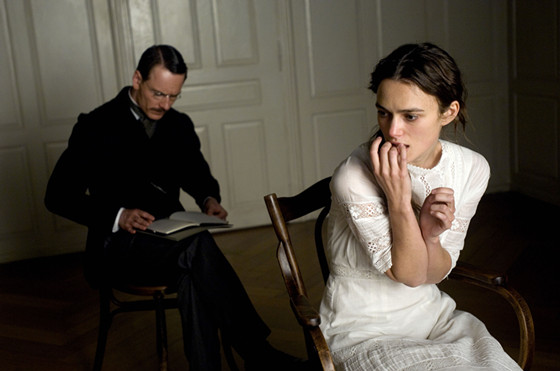
A Dangerous Method
A film to focus on the topic of female hysteria. The spotlight falls on psych forefathers Sigmund Freud, Carl Jung and his disturbed patient Sabina Spielrein.
Directed by David Cronenberg, the film is an interesting depiction of early psychological practices and as well as an investigation into their ethics.
Sabina arrives at Burgholzi psychiatric hospital a hysterical mess. Through talk therapy with Carl Jung (Michael Fassbender), they discover that the source of her illness was derived from the trauma of being spanked by her father as a child and the shame she felt over the arousal she experienced during the act.
Transference between the two inevitably develops and eventually Jung takes some advice from his librarian colleague Otto Gross and takes therapy to a physical level, stepping in as the father figure and entering into a BDSM relationship with Sabina.
Many critics felt that Keira Knightley’s performance was over the top, which many be true. Nonetheless, she plays a compelling character. The real Sabina Spielrein ended up being one of the first female psychologists. A hearty feat considering it was a field diluted by misogyny. Feminist in her own right, both Jung and Freud immediately recognized her intelligence.

Coimbra: Faculdade de Psicologia é das melhores

Latada 


É a única universidade nacional representada no ranking do Centro de Desenvolvimento Universitário alemão

5 de Novembro de 2009 às 20:21 Redação / AB
 
A Universidade de Coimbra (UC) é a única portuguesa representada no ranking do Centro de Desenvolvimento Universitário, uma instituição independente alemã, sendo destacada a área da Psicologia.

Segundo um comunicado da UC, o CHE - Excelence Ranking «permite fazer uma comparação das melhores instituições universitárias e centros de investigação na Europa, sendo particularmente dirigido a futuros estudantes de mestrado e doutoramento», noticia a Lusa.

«São pouco mais de 100 instituições de Ensino Superior que oferecem, na Europa, excelentes perspectivas para estudantes de mestrado e de doutoramento e que integram o Grupo de Excelência do CHE»- Excellence Ranking, publicado pelo semanário alemão «Die Zeit».

A directora da Faculdade de Psicologia e Ciências da Educação da Universidade de Coimbra (FPCEUC), Luísa Morgado, disse que o CHE escolheu avaliar o mestrado integrado em Psicologia ministrado na instituição e que este foi o único avaliado na UC e no país.

Em três critérios do ranking, este mestrado integrado atingiu os níveis de excelência, nomeadamente no número de publicações ou citações e orientações internacionais, na existência do mestrado Erasmus Mundus e na mobilidade do corpo docente e discente, adiantou a responsável.

«É uma grande distinção para a Faculdade figurar num ranking de excelência europeu», afirmou a directora da FPCEUC, referindo que existem 39 cursos de licenciatura e mestrado integrado em Psicologia no país.

«Recentemente, o ranking elaborado pelo jornal, o britânico «The Times», apresentava como único representante do sistema de Ensino Superior português a Universidade de Coimbra, situando-a entre as 400 melhores universidades mundiais e as 200 melhores europeias», concluiu. 
 

segunda-feira, 2 de novembro de 2015

Test your Level of English Grammar/Vocabulary

Not bad, at first attempt... :)

Dear Edgar Casimiro,
Thank you for completing the English Level Test at www.examenglish.com/leveltest
This tested your level of English grammar and vocabulary.
Congratulations! Your level is C2 (advanced/mastery)
This is approximately equivalent to CPE, an IELTS band score of 9 (1 to 9) or 120 (120/120) at TOEFL iBT
Time taken: 27 minutes, 39 seconds
Date: 02/11/15

 http://www.examenglish.com/leveltest/grammar_level_test.htm

Employee Behavior Standards in the Workplace

by Audra Bianca, Demand Media
In many organizations, employees must meet standards of professional behavior as a condition of employment. These standards help an organization create a respectful working environment for everyone. If you learn the standards that govern your workplace, you can ensure that your behavior is acceptable and prepare to succeed in your job. Acceptable behavior is also required for acceptance into the workplace culture.

Code of Conduct

Organizations provide a code of conduct to explain which behaviors are and are not permitted by employees. In addition, employees can be required to acknowledge this code by signing an agreement upon employment. Employees who violate the standards face consequences through a standard policy, such as a progressive discipline system, which has grave consequences for the most serious violations. Also, employees may get a warning for the first occurrence of a less-serious violation, but they would get a more severe consequence for another occurrence of the same behavior. Progressive discipline gives employees a chance to change their behavior and continue employment.

Interpersonal Communication

Some examples of unacceptable behavior may be included in a policy containing employee behavior standards, but an employer will usually include language such as "not limited to" to allow for disciplining employees who have committed other unacceptable behaviors. Employers will not tolerate inappropriate ways that employees treat others at work, including co-workers, superiors, customers and visitors. Examples are bullying, harassment, intimidation, belittling others, undermining a person's performance by withholding information, spreading gossip to hurt a person's reputation, or making offensive gestures or comments. These kinds of behaviors could include communication through technologies such as cell phone messages, text messages, social media posts and emails.

Administrative Behavior

Other forms of behavior that could impact an organization relate to the misuse of power or resources. Managers have many expectations governing their use of authority. Managers shouldn't give preference to people for unfair reasons, such as employing friends or relatives. They also shouldn't claim expenses for items such as mileage, business lunches, airfare or hotel accommodations if they were really personal expenses. All employees should be honest in communications regarding employees and delivering information to customers. Without a policy that covers how employees can abuse power or resources, some employees will find unethical ways to benefit from their employment in an organization.

Revising the Rules

Every organization has an opportunity to get employees involved in rewriting the rules of professional behavior. Employees may want to include behaviors such as bullying or social media gossip that were not addressed in current behavior standards. Employers may address employee concerns by adding separate policies for some areas of professional behavior. For example, an employer could write a separate policy to address bullying, travel reimbursement, outside employment, financial disclosure or acceptable use of technology. Special policies provide details that will help employees better understand how to conform to an employer's expectations.

Behavioral Goals in the Workplace

by Sam Ashe-Edmunds, Demand Media
What you don’t do at work can be just as important as what you do when it comes to your behavior. How you interact with other employees and managers can help you get noticed and climb the company ladder. Manage your workplace behavior, as well as your work responsibilities, to make yourself known as a productive team player who might be management material.

Follow the Rules

Get a copy of your company policy manual or ask for any written policies and procedures and get to know them inside and out. Just because everyone else might be violating a particular policy doesn’t mean management won’t eventually clamp down. If and when that happens, you don’t want to be known as one of the rule breakers who caused them to address the problem. Follow common sense rules, even when it comes to little things such as keeping your desk clean, not leaving cups or dishes in the break room sink, dressing professionally and putting paper in the copy machine when you empty it.

Practice Good Attendance

Get to work early instead of cutting it close everyday. Not only will you avoid coming in late, you’ll also get noticed as someone who’s responsible and ready to get to work. Don’t take long lunches even if your coworkers are doing it. Use a polite excuse such as, “I’ve got to get some emails out soon,” rather than lecturing peers who stretch lunches. Don’t watch the clock or “wind down” toward the end of the day. If you have your coat on five minutes before it’s time to go and you’re chatting with coworkers, your boss will know you likely stopped working 15 minutes or more early.

Don’t Gossip

Don’t start gossip, repeat it or respond to it. Even if you only listen and comment to others, coworkers who get caught gossiping might defend themselves by saying, “But John thinks so, too!” In addition to personal gossip, don’t discuss other’s work habits, mistakes the company has made, or your disappointment with your boss, responsibilities, pay or bonus. Don't reveal too much about your personal life, either. The less people know about your relationships, hobbies, family members or politics, the less gossip material they will have on you.

Volunteer

Asking coworkers if they need any help, or asking supervisors if you can take on extra responsibility, shows you are committed not only to doing your job well but also helping the company succeed. This is known as taking initiative and shows that you are more than a worker drone or an employee with no drive. Don’t offer to help if it will affect your ability to get your own work done, however. Helping others is no excuse for not meeting your responsibilities. Only offer help when you know you have the time to provide it.

Schedule Your Week

Create a to-do list each week and schedule when each task needs to be completed to ensure your work gets done. Even if you’re a conscientious worker, others might not hold up their end of the workload, and this can throw off your timetable. Create Plan B scenarios to be able to handle problems, such as a coworker or supplier not delivering what they promised. For example, if you have a project due on Thursday afternoon and need some numbers from accounting to finish the project, don’t ask accounting for the numbers by Thursday morning. Request them for Wednesday delivery, giving you Thursday as a backup date in the event computers crash, someone takes a sick day or a peer simply forgets your request.

http://work.chron.com/behavioral-goals-workplace-17456.html

Interpersonal Skills Test


Individuals with high interpersonal sklls are likely to score highly in many, or even all of these measures, whereas individuals showing low interpersonal skills may express lower scores on many of these measures. 
Individuals with high interpersonal sklls are likely to score highly in many, or even all of these measures, whereas individuals showing low interpersonal skills may express lower scores on many of these measures.  Want to try our free full length personality test? Click here or click on the "Personality" tab at the top of the webpage. 

Emotional Intelligence
Emotional intelligence is the ability to assess, identify and control emotions, both in oneself and in other people. A score of 41 indicates a high level of emotional intelligence. You are able to recognise, evaluate or utilise the emotions of others and of yourself very effectively. You are quick to identify why people become emotional and why emotion is affecting their behaviour. When making decisions, emotional factors will have a major impact on the decision making process, and on the final course of action.
Team working
Team working is the ability to cooperate with co-workers in order to achieve goals or objectives. A score of 44 indicates a high preference for team work. You are significantly more likely to perform well in a team compared to working individually. Your performance is almost always enhanced when working as part of a team. When individuals begin to slack, or are overly dominant within the group, you tackle the issue almost immediately, in the interest of the group.  
Empathy
Empathy is the capacity to recognise emotions that are being experienced by yourself and by other people. A score of 43 indicates a high level of empathy. You very readily notice emotions in other people, often through subtle emotional clues. You are well aware of your own emotional state and regularly pick up on your own emotional clues early on. People recognise you to be very well in touch with your own emotions and those of other people.
Integrity
Integrity is the concept of consistency of action, values and principles, along with one’s honesty and truthfulness. A score of 46 indicates a high level of integrity. Your actions are heavily based on your own personal principles and values. You are unwilling to bend your principles, even if it is in your interests to do so. You almost always express honesty and truthfulness, having much difficulty in bending the truth.
Social Boldness
Social boldness is the exhibition of courage, bravery and assertiveness in social situations. A score of 39 indicates a fairly high level of social boldness. You are somewhat more likely to show courage and bravery in social situations than most people. You are more likely to express assertiveness or dominance than many people. People are likely to recognise you as a relatively bold person that is rarely shy. 

O que é um Complexo?

Conheça a definição de Complexo, dada pelo psicólogo C. G. Jung e que influenciou os conceitos de complexo de Édipo e complexo de inferioridade. 


The 12 Most Visually Stunning Black and White Films of The 21st Century

20 March 2015 Features, Film Lists by Alexandra Gandra
 

best b&w films 21st century

The amount of feature films shot in black and white has overwhelmingly declined since the 1960s, being replaced by a quick growing ratio of those shot in color. From that moment on, monochromatic photography or any kind of technique that goes against digital development has been used for effect, or sometimes cost. Either it being originally shot in color and manipulated back to B&W, either being shot on conventional emulsion film, it has become a niche enterprise over the last decades.
Black and white filmmaking became especially sparse since the 1980s and, although quite a few superb films were made in monochrome in the 20 years that preceded the 21st century, there are entirely new approaches to this type of filmmaking that are worth analysing, having in mind the most recent advances in technology, storytelling and the minds of some of the best modern filmmakers.
What’s more important here, though, is how these new techniques have been adapted to the visual strengths of classical black and white features – and how every single one of these pictures have reminded us that B&W and occasional silent films don’t just belong in the past.
Instead, their possibilities are being more and more explored, resulting in magnificent works of art and visual wonders that any true fan of cinema can appreciate. Please note that these films are not ranked in any particular order, as all of them offer unique qualities when using B&W.

1. Tabu (Miguel Gomes, 2012)
tabu 2012

Inspired by FW Murnau’s 1931 silent film of the same name and as an homage to classic cinema, Portuguese filmmaker Gomes explored the past and the golden era, as well as the colonial 1960s. The film uses the visual aesthetics of a Hollywood silent film, shot in black and white with early cinema’s 1.33:1 aspect ratio.
It’s divided in three parts, one being a prologue centered around a crocodile. The two main parts show present-day Pilar (Teresa Madruga), a Catholic woman who’s concerned about her elderly neighbor Aurora (Laura Soveral), who happens to be addicted to slot machines and has now spent all her money. The next section takes us to Aurora’s youth in Africa, and her love story with the adventurer Ventura (Carloto Cotta).
There is no dialogue here, leaving room for ambient sounds, musical performances and a hypnotic narration that lasts nearly an hour. How Gomes separated the parts is what really stands out visually: in the depicted present-day, the pace is slow and patient with long speeches, filled with vivid detail; the past is fast, experimental, playful even – a reference to cinema’s own changes through time.

15 Great Non-English Language Film Trilogies That Are Worth Watching

24 February 2015 Features, Film Lists by Ivan Andonov
 
Three Colors Blue (1993)


There is definitely something appealing about the word trilogy. In any art, but in cinema especially. Whenever somewhere in the world someone says, “You know, I really loved Fassbinder’s Lola,“ or, “Man, I finally saw that Oldboy movie; it’s really something else!,“ on nine out of ten of the occasions the answer will be, “Yeah, it’s a good one, but, you know, it’s a part of a trilogy. Now you must see the other two.“
While there are plenty of lists on the web that deal with the best trilogies of cinema in general, where one can usually find only two to three entries from this list, while the usual high-budget winners range from The Lord of the Rings via Oceans to The Godfather trilogy, this list focuses on the mastership of non-English speaking cinema which, rather expectedly, narrows down exclusively to Europe and Asia.
Some of them are “unintentional trilogies,“ yet some of them deliberate, here is the list of the top fiften of which have somehow changed the history of cinema.

15. Millennium series (SWEDEN, Niels Arden Oplev/Daniel Alfredson)
The Girl With The Dragon Tattoo (2009), The Girl Who Played With Fire (2009), The Girl Who Kicked The Hornets’ Nest (2009)


The Girl With the Dragon Tattoo (2009)

Millenium series is the first, and probably most, unintentional trilogy on the list. The now-bestselling, late writer Stieg Larsson intended to write ten installments of the series, but his sudden death (which, by the way, is painfully comparable to the death of another great writer of his era, Douglas Adams), cancelled his plans before he could finish the number four.
In 2008, four years after his death, Larsson became the second best-selling author of the world, behind Khaled Hosseini, which naturally led to the filming of the trilogy. All three installments were finished and premiered in 2009.
Thanks to the popularity of the trilogy, you probably already know that its plot evolves around Lisbeth Salander, an extremely intelligent young woman with a troubled childhood, a role which launched the actress Noomi Rapace to the universe of Hollywood industry. The really important part is the origin of the whole idea, which is as dark as it can be – when he was fifteen-years-old, Larsson witnessed the gang rape of a girl and was too scared to help her, thus he was left with a lifelong trauma.
One should follow the golden rule that the original is always far better than its US remake (Oldboy being the most recent example) and therefore see these three films and pass on David Fincher’s 2011 version of The Girl With The Dragon Tattoo.

domingo, 1 de novembro de 2015

Raising awareness of workplace mental health


(Fotolia)

By Heather Rivers, Woodstock Sentinel-Review
WOODSTOCK - It is costing Canadians billions in workplace dollars a year.
“It’s huge thing when you look at the cost to employers for untreated mental health issues,” said Christy Kent, a crisis outreach and specialized service work. “Fifty-one billion is lost each year in Canada.”
According to the Canadian Mental Health Association, which is raising awareness about the issue during Canada’s Healthy Workplace Month, in any given week more than half a million Canadians will be absent from work because they are struggling with mental health issues.
Seventy per cent of disability costs are related to mental illness, and globally by the year 2020, it is predicted depression will rank second only to heart disease as the leading cause of disability.
“Stress, anxiety and mood disorders like depression are the most common mental health problems that impact the workplace,” said Mark Henick, program manager for Mental Health Works, a social enterprise of CMHA. “It’s important for the employee to reach out and ask for help, but its equally important for employers, managers and supervisors to better understand mental health issues and develop approaches to intervene at any stage of the problem.”
Untreated mental health issues can also lead to a condition called presenteeism, which occurs when employees go to work with untreated mental health issues because they are unaware of supports or won’t get help due to stigma.
“They are not operating at their highest level of production,” Kent said.
Kent said dealing with the issue of workplace mental health “is something employers are slowly getting on board with.”
She recommends employers have literature available to their workers, as well, employers are encouraged to have strategies in place to solve conflicts, create an achievable workload, and help with their employees' work/life balance.
“Having different strategies within the workplace is very important,” Kent said.
She also suggests workplace committees be put in place to deal with issues surrounding mental illness, follow up issues and gathering information and data.
Tips for employers, managers or supervisor (courtesy CMHA Ontario)
  • Look for signs such as behaviour changes, consistent late arrivals or absences, decreased productivity or poor work.
  • Talk about it with the employee to raise concerns and offer help. Beforehand find out what resources are available for the employees.
  • Build comfort by minimizing stress not contributing to it. It’s important to talk about how the employee is valued before raising concerns. Be honest, upfront, professional and caring in your approach.
Tips for employees
  • Talk to your doctor, because one in five people will experience a mental health problem this year but only one-third will seek help. Depression is treatable, and most people who receive the right supports recover fully.
  • Connect with a professional counsellor because combining counselling with medical treatment is considered generally more effective than utilizing just one. A psychologist, a psychotherapist or a social worker has specialized training to help learn new coping skills.
  • Reach out to those you trust because close personal connections are one of the most powerful, healing and protective tools to combat depression.
  • Live well by exercising, getting enough sleep and healthy eating. Research shows that making a conscious choice to lead a healthier lifestyle — especially when you don’t feel like it — can boost your mood.

Arquivo do blogue

Acerca de mim

London, Harrow, United Kingdom